Path Tracing in Games Explained: Why ‘Full Ray Tracing’ Is Different
What path tracing is, how it differs from hybrid ray tracing, why it depends on denoising and upscaling, and the games that brought it to real time.
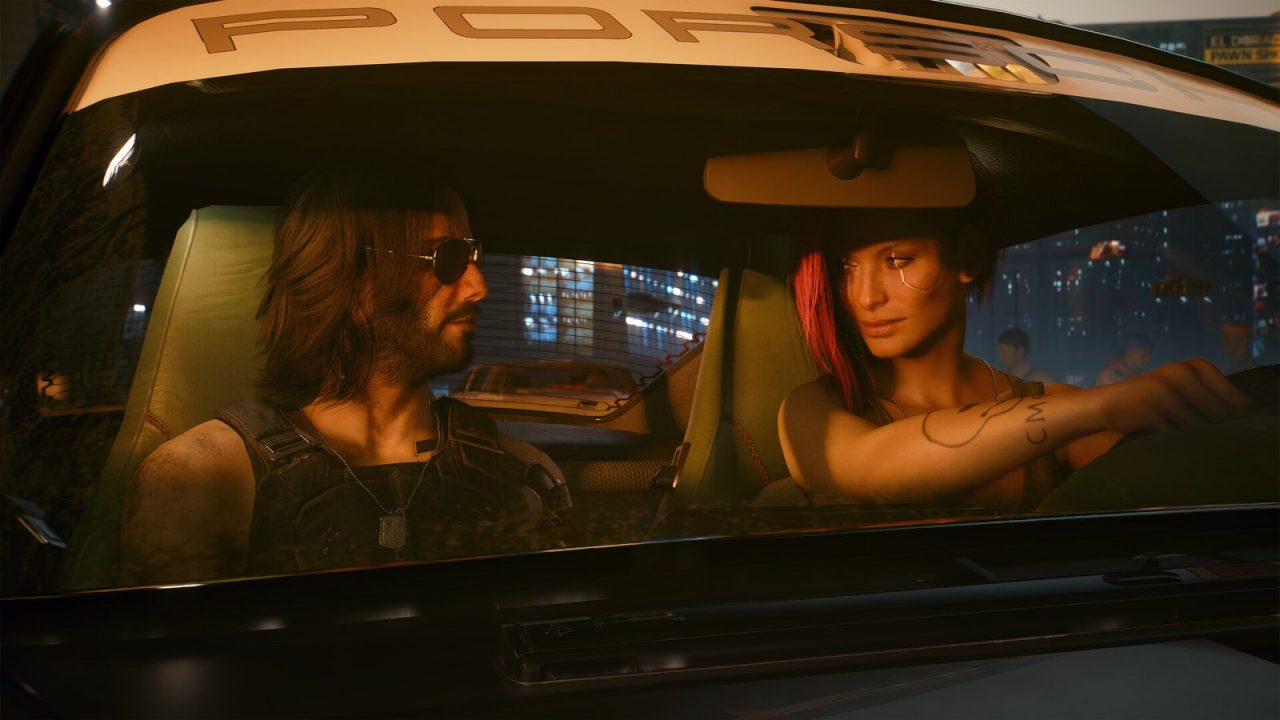
For years, “ray tracing” in games meant a few selected effects: better reflections in one game, sharper shadows in another, ray-traced ambient occlusion in a third. Then a small group of games began offering something more radical, labeled “path tracing” or “full ray tracing.” Screenshots looked noticeably different, more like offline-rendered film frames, and the performance cost was much higher.
This article explains what path tracing actually is, how it differs from the hybrid ray tracing most games use, why it only became possible in real time with heavy help from denoisers and upscalers, and which games pioneered it. If you are new to the basics of rays, start with our plain-English ray tracing explainer.
Path tracing in one paragraph
Path tracing is a way of computing lighting by following the possible paths light can take through a scene. For each pixel, the renderer shoots a ray from the camera into the world. When it hits a surface, it picks a new direction (based on the material: shiny surfaces send rays in a tight cone, rough ones scatter them widely), and continues. At each bounce it also checks the contribution of light sources. Following this path for several bounces, and averaging many such random paths per pixel, gives an estimate of all the light arriving at that pixel: direct light, shadows, reflections, color bleeding, soft indirect light and ambient occlusion, all from one unified process.
Because path tracing is a statistical (Monte Carlo) method, it converges toward a physically plausible result as the number of samples rises. Film studios have used path tracing for years in offline renders that take minutes or hours per frame. Games have roughly 16 milliseconds per frame at 60 fps, which is the whole challenge.
Hybrid ray tracing vs path tracing
Most ray-traced games use a hybrid approach. The image is still rendered primarily with rasterization, and ray tracing is added for specific effects that rasterization handles badly:
- Ray-traced reflections replace screen-space reflections.
- Ray-traced shadows replace shadow maps for some lights.
- Ray-traced ambient occlusion or global illumination replaces screen-space approximations.
Each effect has its own budget, its own denoiser and its own shortcuts, and many lighting aspects remain rasterized approximations. This works well and is far cheaper, but the pieces don’t always agree with each other, and artists still need fallbacks and manual tweaks.
A path-traced mode replaces these separate techniques with one algorithm that handles all lighting together. NVIDIA’s description of Cyberpunk 2077’s Overdrive mode, for example, says path tracing replaced screen-space reflections, screen-space ambient occlusion and the earlier global illumination with a single unified algorithm. The camera rays themselves may still start from a rasterized buffer of what is visible (a common optimization), but the lighting is computed by tracing paths.
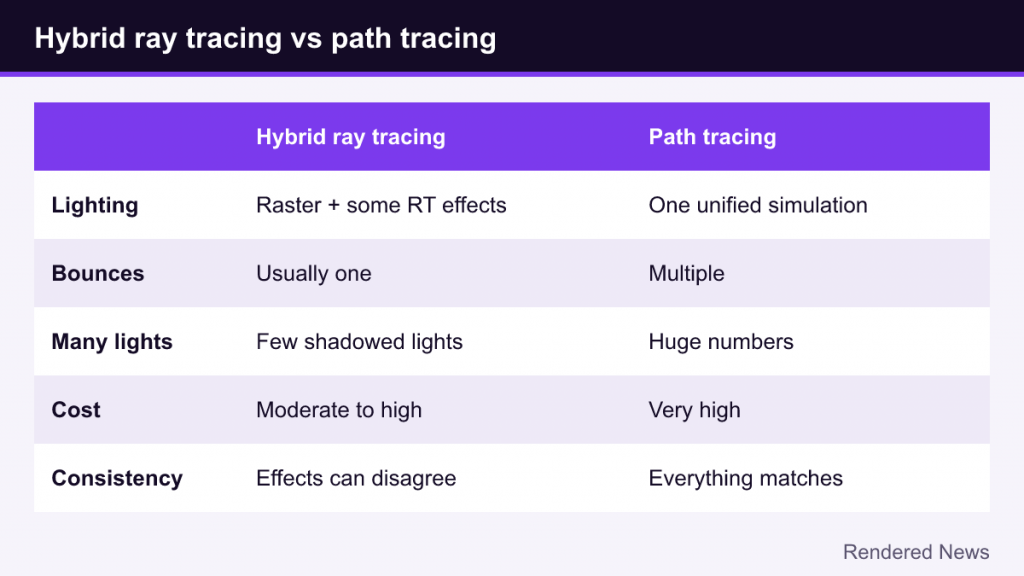
| Hybrid ray tracing | Path tracing (“full RT”) | |
|---|---|---|
| Lighting model | Rasterized lighting plus selected RT effects | One unified light transport simulation |
| Bounces | Usually one, for specific effects | Multiple bounces of light |
| Many light sources | Limited; often few shadowed lights | Can sample huge numbers of emissive surfaces |
| Cost | Moderate to high | Very high, needs upscaling and denoising |
| Consistency | Effects can disagree | Shadows, reflections and GI match naturally |
The sample problem: why path tracing is noisy
An offline film renderer may trace hundreds or thousands of paths per pixel. A real-time game can usually afford only around one path per pixel, sometimes less, and only a few bounces. With so few samples, the raw image is extremely noisy: speckled pixels, especially in shadowed areas and in places lit only by indirect light.
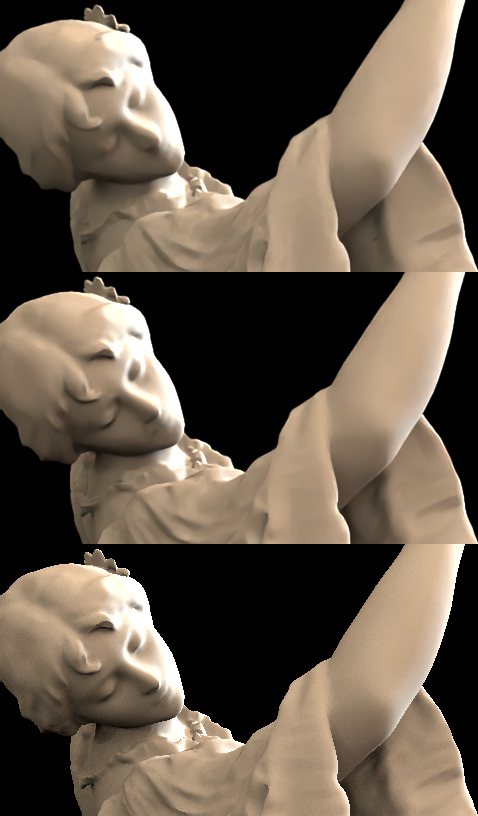
Turning that noisy estimate into a clean image relies on three ideas working together.
1. Smarter sampling
Rather than picking light directions at random, modern techniques try to send rays where they will matter most. The most influential family here is ReSTIR (Reservoir-based Spatiotemporal Importance Resampling), introduced in a 2020 paper by Benedikt Bitterli and colleagues from Dartmouth College and NVIDIA. In general terms, each pixel keeps a small “reservoir” of promising light samples and shares good candidates with neighboring pixels and with the same pixel in previous frames. Effective sample counts become far larger than the rays actually traced. The original paper focused on direct lighting from millions of emissive triangles; follow-up work extended the idea to global illumination and full paths. NVIDIA’s RTX Direct Illumination (RTXDI) SDK, used in Cyberpunk 2077’s Overdrive mode, builds on this research.
2. Denoising
Denoisers filter the noisy result using information from neighboring pixels and previous frames, guided by extra data such as surface normals, depth and motion vectors. Traditional real-time denoisers are hand-tuned filters, often one per effect. More recently, machine-learning approaches like NVIDIA’s DLSS Ray Reconstruction replace several hand-tuned denoisers with one trained network; NVIDIA described it as doing exactly that when it launched alongside Alan Wake 2’s path tracing.
3. Upscaling and frame generation
Path tracing at native 4K is out of reach for real-time budgets, so path-traced modes almost always render at a lower internal resolution and use temporal upscaling to reach output resolution. Many also pair it with frame generation. Our guide to DLSS explains how those NVIDIA technologies work. In practice, a “path tracing” mode is a whole stack: smart sampling, a denoiser, an upscaler, and often generated frames, with each piece compensating for the limits of the others.
Landmark path-traced games
Quake II RTX (2019)
Released by NVIDIA on June 6, 2019, Quake II RTX remade the 1997 shooter’s renderer with real-time path tracing on Vulkan. It built on an earlier research project, Q2VKPT. Quake II’s simple geometry made it an ideal proof of concept: the scenes were light enough that full path-traced lighting could run on the first generation of ray tracing GPUs.
Minecraft with RTX (2020)
Minecraft’s RTX version, released in beta on Windows in 2020, brought path-traced lighting to a hugely popular game, showing how emissive blocks, water and glass behave when light transport is simulated rather than approximated.
Portal with RTX (2022)
Released on December 8, 2022 as a free download for owners of Portal, this remaster from NVIDIA’s Lightspeed Studios used full path tracing and showcased RTX Remix, NVIDIA’s platform for remastering classic games with modern lighting.
Cyberpunk 2077: Ray Tracing Overdrive (2023)
On April 11, 2023, Cyberpunk 2077 received a “technology preview” mode called Ray Tracing: Overdrive, bringing path tracing to a large, modern open-world game. It used RTXDI for its many light sources, NVIDIA’s real-time denoisers and DLSS 3, and became the standard showcase for what full ray tracing could do in a dense city.
Alan Wake 2 (2023)
Remedy’s Alan Wake 2, released on October 27, 2023, shipped with path tracing at launch, alongside DLSS 3.5 Ray Reconstruction. Its presets illustrate the cost trade-off: NVIDIA’s launch article described a medium setting with one bounce of light and a high setting with full path tracing and up to three bounces.
Since then, path tracing or “full ray tracing” modes have appeared in more big releases. They remain optional, high-end settings rather than defaults.
What path tracing changes visually
The differences are often subtle in single screenshots and obvious in motion:
- Indirect lighting and color bleeding: rooms lit only by bounce light look correct, with colored light picked up from walls and floors.
- Every light casts shadows: neon signs, screens and small lamps cast soft, accurate shadows instead of being “unshadowed” fill lights.
- Grounding: objects and characters sit in the scene with natural contact shadows and occlusion.
- Consistent reflections: reflections show correctly lit objects, including off-screen ones, and even reflections within reflections.
The trade-offs show up too: residual noise in dark areas, smearing or lag in lighting changes from temporal accumulation, and occasional denoiser artifacts on fine details like foliage or hair.
Path tracing vs systems like Lumen
Real-time global illumination systems such as Unreal Engine 5’s Lumen also trace rays, but they lean heavily on simplified scene representations and caches to keep costs down. Path tracing is more brute-force: it traces actual geometry, with fewer approximations, and relies on sampling tricks and denoising instead of caches. Our Lumen explainer covers that approach. The two are not rivals so much as points on a spectrum between speed and physical completeness, and engines increasingly offer both: a cached real-time GI system for most players, and a path-traced mode for top-end settings or reference renders.
Common misconceptions
- “Path tracing is just more ray tracing.” It is a different structure: one unified simulation of light paths rather than several separate ray-traced effects.
- “Path-traced games render at full resolution.” In real time they almost always rely on upscaling and denoising.
- “Path tracing is always physically accurate.” Games still limit bounces, clamp values and use approximations for performance. It is more physically based, not perfect.
- “If it’s noisy, the game is broken.” Some noise in dark scenes is inherent to low-sample path tracing; higher quality settings and better denoisers reduce it.
Where it is going
Path tracing in games went from a tech demo on a 1990s shooter to a selectable mode in large open-world releases within a few years, driven by better sampling algorithms, faster ray tracing hardware and machine-learning denoising and upscaling. It is still expensive, and it still sits at the top of the settings menu rather than the default. But the direction is clear: more and more of the lighting in real-time graphics is being computed by simulating light rather than faking it.