How Video Games Are Made: From First Idea to Release
Follow a game from first idea to launch: concept, pre-production, prototyping, production, alpha, beta, certification, release and post-launch updates.
When a game is announced, players usually see a trailer, a release window and, a few years later, the finished product. What happens in between is mostly invisible: hundreds of small decisions, thousands of assets, countless bugs fixed and features cut. Understanding that process explains a lot about the games we play, including why delays happen, why launch-day patches exist and why some ambitious projects change shape along the way.
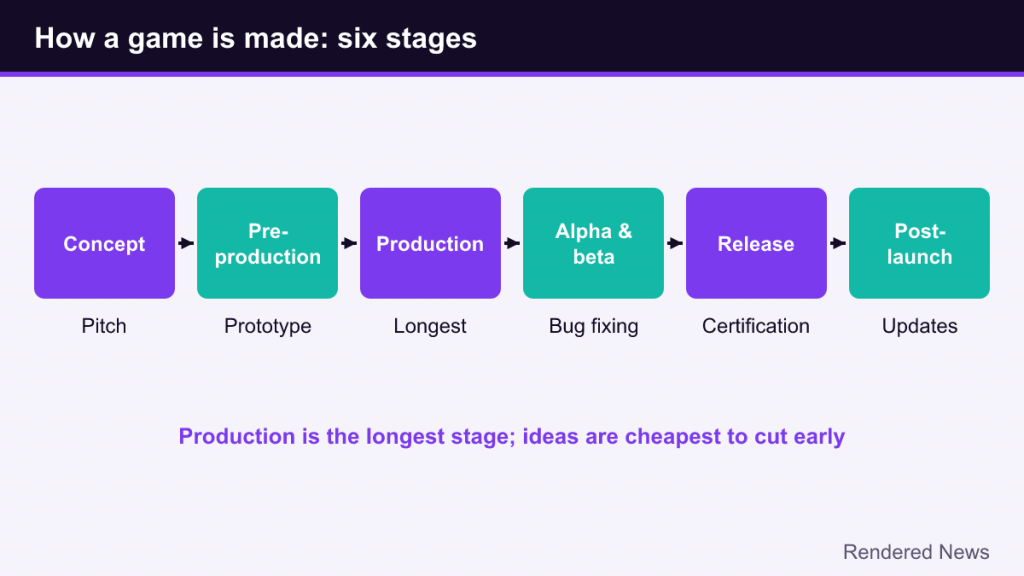
This guide walks through the typical lifecycle of a video game, from the first idea to life after launch. Every studio works a little differently, and terms vary between companies, but the broad stages below are common across the industry, from two-person indie teams to large studios.
Stage 1: The concept
Every game starts as an idea, but an idea alone is not a plan. In the concept stage, a small group (sometimes one person) works out what the game is and why anyone would want to play it. Common outputs include:
- A high concept: a one- or two-sentence description of the game. For example: “A cooperative cooking game where kitchens fall apart while you cook.”
- Core pillars: three or four principles that every later decision should support, such as “tense but fair combat” or “every room tells a story.”
- Target audience and platforms: who the game is for and where it will run, which affects everything from controls to visual budget.
- Reference material: mood boards, games with a similar feel, and early concept art.
For a studio working with a publisher, this stage usually ends with a pitch: a presentation, document and often a small playable demo used to secure funding or internal approval. Many ideas never get past this point, and that is by design. It is far cheaper to reject an idea on paper than after a year of production.
Stage 2: Pre-production and prototyping
Pre-production is where a team proves the game can work and figures out how to build it. Teams are usually small at this point, made up of designers, a few programmers, concept artists and a producer.
Prototyping
Prototypes answer specific questions as cheaply as possible. Is the core mechanic fun? Does the camera work in tight spaces? Can the engine handle the number of enemies we want? Prototypes are usually ugly, using placeholder shapes (“graybox” or “blockout” geometry) instead of real art, because the goal is to test the feel, not the look. Many promising ideas are discarded here, and that is a success, not a failure.
Planning the production
In parallel, the team makes the decisions that shape the rest of development:
- Engine and technology: license a commercial engine, use an open-source one or build on an in-house engine. Our guide to what a game engine is explains what that choice involves, and our engine comparison covers the three most common options for smaller teams.
- Art direction: style guides, color palettes, character and environment concepts.
- Design documentation: a game design document or living wiki describing mechanics, systems and content.
- Pipelines: how assets move from tools like Blender or Maya into the engine, naming conventions, version control and build processes.
- Schedule and scope: how many levels, characters and features, and how big the team needs to be.
The vertical slice
Many larger projects end pre-production with a vertical slice: a short section of the game built to near-final quality, with real art, audio, UI and gameplay. It shows that the team can hit its quality bar and gives a realistic measure of how long content takes to make. If one polished level took three months, that number feeds directly into the production plan.
Stage 3: Production
Production is the longest stage and the one where most of the team is hired or assigned. The goal shifts from “what is this game?” to “build all of it.”
Who does what
- Designers build levels, tune systems, write quests and balance difficulty.
- Programmers write gameplay code, AI, UI, tools for other developers, networking and performance-critical engine work.
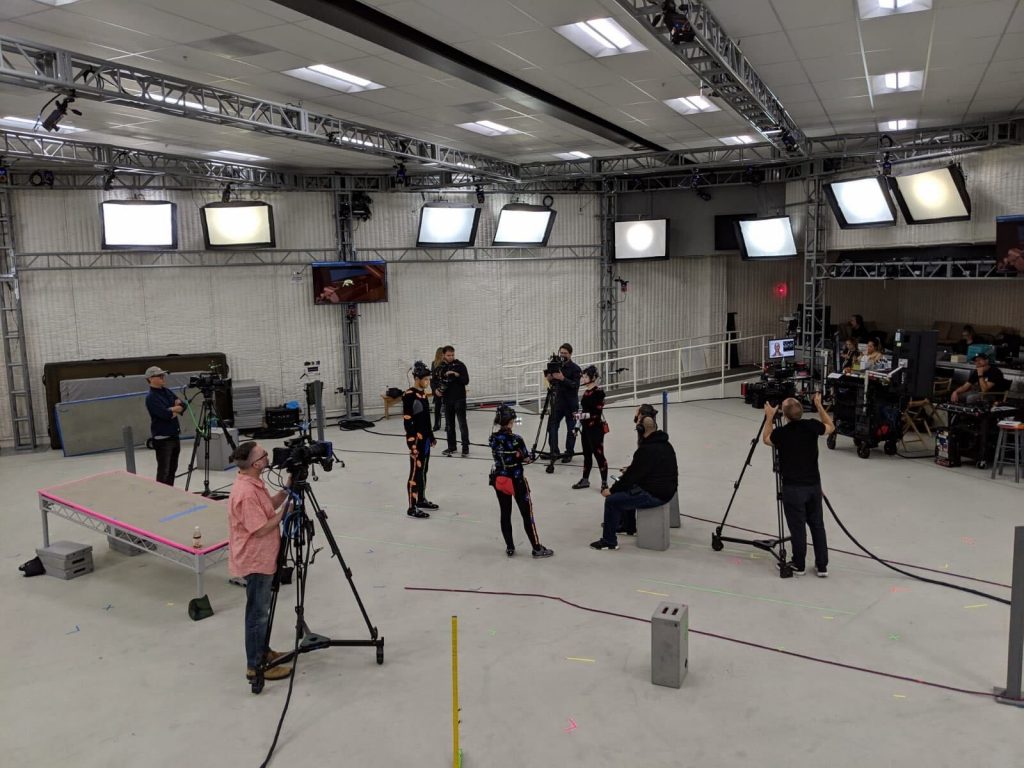
- Artists create concept art, 3D models, textures, environments, characters, animations, visual effects and UI graphics. Technical artists bridge art and code, writing shaders and tools.
- Audio teams make sound effects, music and implement them in the game, while voice actors record dialogue.
- Writers handle story, dialogue and in-game text.
- Producers manage schedules, priorities and communication, and keep the team unblocked.
- Quality assurance (QA) testers find and report bugs, check fixes and verify that features work as intended.
In a small indie team, one person may cover several of these roles. In a large studio, each may be its own department, with outsourcing partners creating some art, animation or porting work.
Iteration and cutting
Production is not a straight line. Playtests reveal that a mechanic is confusing, a level is too long or a feature does not fit. Teams constantly revise, and they also cut. Features, levels and even characters are removed because they are not working or will not be finished in time. Cutting is one of the hardest and most important skills in game development, because the alternative is a game that never ships.
Stage 4: Alpha and beta
As production matures, games pass through milestones that signal how complete they are. Definitions vary between studios and publishers, but the common meanings are:
| Milestone | Typical meaning |
|---|---|
| First playable | The core loop can be played start to finish in a rough form. |
| Alpha | Most or all features are implemented, though content may be placeholder and bugs are common. New features are discouraged after this point. |
| Beta | Content is complete. The focus is on fixing bugs, performance and polish rather than adding anything new. |
| Release candidate / gold | A build the team believes is ready to ship, submitted for final approval. |
Note that a public “beta test” is a different thing. Publishers often run open or closed betas for marketing and server stress tests, and the build players see may be older than the team’s internal version.
Late development is usually dominated by bug fixing. QA logs issues with steps to reproduce them, producers prioritize, and programmers and artists work through them. Performance optimization also intensifies here: hitting frame-rate targets, reducing loading times and fitting within memory limits on each platform.
Stage 5: Certification, ratings and release
Platform certification
Before a game can launch on a console, the platform holder (Sony, Microsoft or Nintendo) must approve it. Each publishes technical requirements covering things like how the game handles save data, user accounts, network disconnections, system messages and suspend-and-resume. The build is tested against these requirements, and if it fails, the team fixes the issues and resubmits. PC storefronts and mobile app stores have their own review processes, generally lighter than console certification.
Age ratings
Games sold in many regions also need age ratings, such as ESRB in North America or PEGI in Europe. For boxed and console games, the ESRB process involves the publisher submitting a questionnaire and video footage of the game’s most extreme content for review by trained raters. Many digital-only storefronts use the International Age Rating Coalition (IARC) system, where a questionnaire generates ratings for participating regions.
Gold and launch
Once a build is approved, the game “goes gold,” a term from the days when master discs were sent for manufacturing. Discs and digital packages are prepared, store pages go live and marketing peaks. Meanwhile, the team keeps working. Because certification and manufacturing take time, there is often a gap between going gold and launch day, and teams use that period to fix more bugs. That is why many games have a day-one patch: it contains fixes completed after the gold build was locked.
Stage 6: Post-launch
Release is no longer the end. After launch, teams typically:
- Monitor crash reports and player feedback, then ship patches for bugs, balance problems and performance issues.
- Add quality-of-life features that players request, such as accessibility options or new settings.
- Release downloadable content (DLC), expansions or, for live-service games, ongoing seasons of new content.
- Port the game to additional platforms.
Some games also launch through early access, where players buy an unfinished version and the developers build it out publicly over months or years. This shifts part of the alpha and beta process into public view and lets player feedback shape the game.
Why games take so long to make
Players sometimes wonder why a sequel takes four or five years. Several factors combine:
- Content volume: every object, animation, line of dialogue and sound must be made, integrated and tested. Modern expectations for detail multiply that work.
- Interdependence: a change to how jumping works can break dozens of levels. Systems interact in ways that are hard to predict.
- Technology: new hardware, engine upgrades and new rendering features demand time to learn and integrate.
- Iteration: fun is discovered through testing, not planned perfectly in advance. Every redesign costs time.
- Multiple platforms: each target has its own performance limits, controls and certification rules.
Delays are often the result of a team choosing more time over shipping something broken, although poor planning and overly ambitious scope also play a role. The industry has also faced long-running criticism over “crunch,” periods of extended overtime near deadlines, and many studios now talk openly about scheduling to avoid it.
What this means if you want to make games
The same lifecycle applies to a weekend project at a smaller scale. Write down your concept in one sentence. Build an ugly prototype to see if the core idea is fun. Plan a scope you can actually finish. Build the content, test it with other people, fix the bugs and cut what is not working. Release it, even if only to friends, and learn from the feedback. Professional studios follow this pattern with more people and more money, but the underlying logic of concept, prototype, production, polish and release is the same.