AMD FSR Explained: From FSR 1 to FSR Redstone
How AMD FSR evolved from a simple spatial upscaler to the ML-based Redstone suite, and what FSR Upscaling, Frame Generation and Ray Regeneration do.
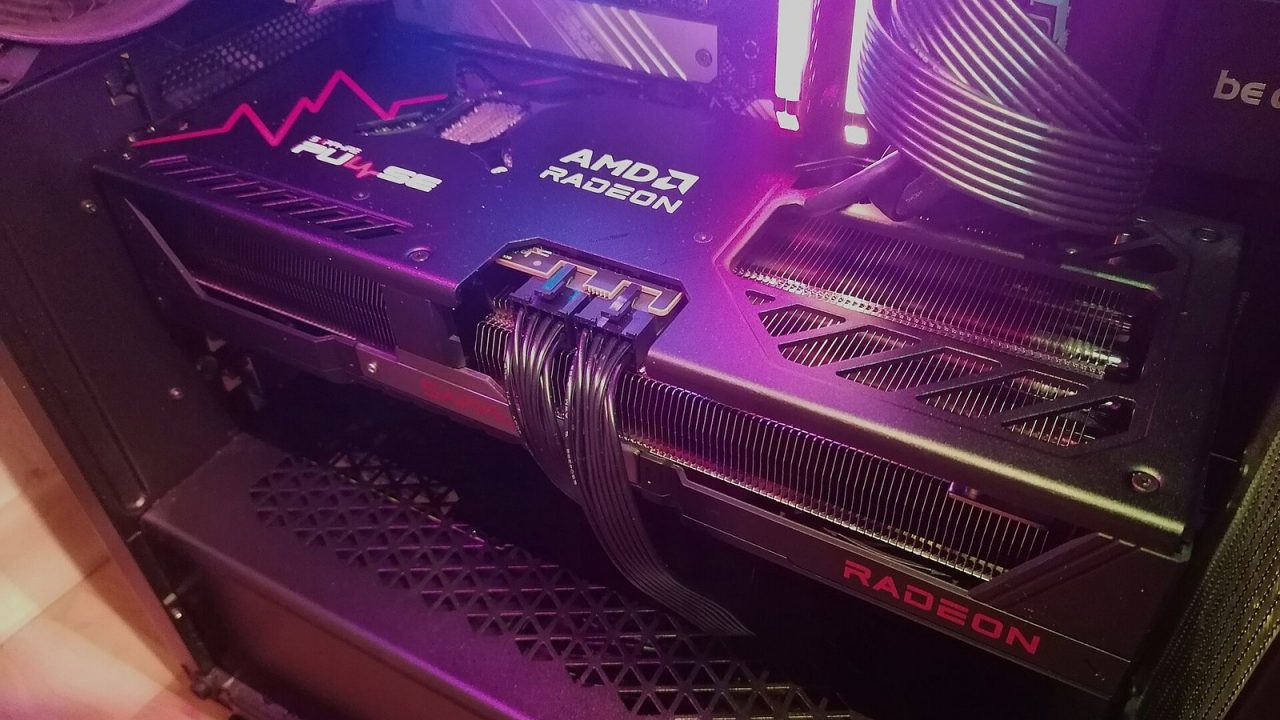
AMD’s FidelityFX Super Resolution, better known as FSR, has changed more than almost any other rendering technology in recent years. It began in 2021 as a lightweight upscaler that worked on nearly any graphics card, became a full temporal reconstruction technique, added frame generation, and then moved to machine learning. In late 2025 AMD rebranded its latest technologies under the FSR Redstone name. This guide walks through each generation, explains what changed under the hood, and clears up the naming as of 2026.
Why upscaling exists in the first place
A GPU’s shading cost grows with the number of pixels it renders. Upscalers render the game at a lower internal resolution and then reconstruct an image at your display’s resolution. The more convincing the reconstruction, the more performance you can reclaim without an obvious loss in sharpness. That reclaimed performance is often spent on ray tracing or higher settings.
There are three broad ways to upscale, and FSR has used all of them:
- Spatial upscaling works from a single frame at a time.
- Temporal upscaling combines information from several frames using motion data.
- Machine-learning (ML) upscaling is temporal upscaling where a trained neural network decides how to combine that information.
NVIDIA’s DLSS went straight to the ML approach, which our DLSS explainer covers in detail. FSR’s story is more interesting precisely because it took the long way around.
FSR 1: spatial upscaling for almost everyone
FSR 1 launched in June 2021. It was a spatial upscaler, meaning it looked only at the current frame. It worked in two passes:
- EASU (Edge-Adaptive Spatial Upsampling) enlarged the image while analyzing local edges to avoid the blurriness of simple bilinear scaling.
- RCAS (Robust Contrast-Adaptive Sharpening) sharpened the result to restore some perceived detail.
Its big advantage was compatibility and simplicity. It ran as ordinary shader code on GPUs from AMD, NVIDIA and Intel, needed no motion vectors, and could be integrated quickly. It even found its way into tools outside games, such as compositors and emulators.
Its limitation was fundamental: a single low-resolution frame simply does not contain the detail that is missing. FSR 1 could make edges cleaner, but fine textures, thin lines and distant objects could not be recovered, and lower quality modes looked noticeably soft or over-sharpened.
FSR 2 and 3: temporal reconstruction
FSR 2, released in 2022, switched to a temporal approach, similar in principle to the temporal anti-aliasing that most modern engines already used. Each frame, the game supplies:
- the low-resolution color image,
- the depth buffer,
- motion vectors for each pixel,
- and a sub-pixel camera jitter offset.
Because the camera jitters slightly every frame, successive frames sample different points. FSR 2 reprojects its accumulated high-resolution history using motion vectors and blends in the new samples, building up detail over time. Hand-written heuristics decide when history should be rejected, for example when an object moves to reveal a background that was previously hidden.
FSR 2 still did not need any special hardware, so it kept the cross-vendor reach of FSR 1 while delivering much better detail. Its weak spots were the classic problems of hand-tuned temporal methods: shimmering on fine geometry like foliage and fences, ghosting behind moving objects, and fizzing around particles and transparencies.
FSR 3, launched in September 2023, kept that upscaler and added frame generation plus a Native AA mode that applies the same reconstruction at full resolution purely for anti-aliasing. FSR 3.1, released in 2024, improved temporal stability, reduced ghosting, and decoupled frame generation from upscaling so developers could pair FSR Frame Generation with other upscalers. It also introduced a more modular API, which later made it possible to upgrade games to newer FSR versions more easily.
The standard quality modes, with internal render scale per axis, have stayed consistent across temporal FSR versions:
| Mode | Scale factor | Render scale per axis |
|---|---|---|
| Native AA | 1.0× | 100% |
| Quality | 1.5× | about 67% |
| Balanced | 1.7× | about 59% |
| Performance | 2.0× | 50% |
| Ultra Performance | 3.0× | about 33% |
FSR 4 and FSR Upscaling: the move to machine learning
With FSR 4, which arrived alongside the Radeon RX 9000 series in early 2025, AMD replaced the hand-tuned heuristics with a neural network. The inputs remain the same (color, depth, motion vectors, jitter), which is why games that had integrated FSR 3.1 could often be upgraded. What changed is how the history and new samples are combined: a trained model makes those decisions instead of hand-written rules.
The practical result is better handling of exactly the cases FSR 2 and 3 struggled with: more stable fine detail, less shimmering in foliage, and fewer disocclusion artifacts. The trade-off is hardware dependence. The ML model was designed around the AI acceleration in RDNA 4 GPUs and their FP8 support.
As part of the Redstone rebrand in December 2025, AMD’s GPUOpen documentation began calling this technology FSR Upscaling, describing it as “formerly” FSR 4. You will still see both names in game menus and articles. In mid-2026, AMD extended FSR Upscaling 4.1 to Radeon RX 7000 series desktop GPUs with an INT8 version of the model, since RDNA 3 lacks FP8 support. For other hardware, AMD provides analytical (non-ML) fallback paths.
FSR Frame Generation
Frame generation creates extra frames between rendered ones, raising the displayed frame rate. FSR’s approach uses motion vectors from the game together with an optical flow analysis computed in shaders, then interpolates an intermediate frame. Because the original FSR 3 frame generation ran in compute shaders rather than on dedicated hardware, it worked across a wide range of GPUs, including those from other vendors.
Like every interpolation-based method, it holds back a rendered frame to generate the in-between one, which adds latency. AMD pairs it with Anti-Lag technologies to offset that, and it works best when the base frame rate is already reasonably high. The Redstone suite added an ML-based Frame Generation for RDNA 4, which aims to reduce artifacts in difficult scenes.
Separately, AMD offers Fluid Motion Frames (AFMF), a driver-level frame generation option that launched in early 2024. Because it works at the driver level, it can be applied to games that never integrated FSR, but it has less information to work with (no game-supplied motion vectors) and does not separate the user interface from the 3D scene, so artifacts on HUD elements are more likely.
The Redstone suite: Ray Regeneration and Radiance Caching
FSR Redstone launched on December 10, 2025, with AMD’s Adrenalin 25.12.1 driver. GPUOpen describes it as four neural rendering features:
- FSR Upscaling: the ML upscaler described above.
- FSR Frame Generation: ML-based frame generation for RDNA 4.
- FSR Ray Regeneration: a machine-learning denoiser for ray-traced effects. Real-time ray tracing produces noisy results because so few rays are traced per pixel; Ray Regeneration cleans that up with a trained model instead of hand-tuned filters. It is conceptually comparable to NVIDIA’s Ray Reconstruction.
- FSR Radiance Caching: a neural approach to global illumination that learns and caches how light bounces in a scene, reducing the number of rays needed for indirect lighting. At launch AMD offered it as a technical preview for developers rather than a shipping game feature.
The full ML suite targets RDNA 4 hardware. AMD also folded its developer toolkit into the AMD FSR SDK, the new name for what was previously the FidelityFX SDK.
GPUOpen and the open-source history
A big part of FSR’s early appeal was openness. AMD’s GPUOpen initiative, launched in 2016, publishes developer tools and effects, many under the permissive MIT license. FSR 1 and FSR 2 source code was published there, which allowed developers to integrate, study and modify the algorithms freely. This is one reason FSR appeared in so many games, engines and even community projects that bring upscaling to older titles.
The ML era complicates this picture. A neural upscaler depends on trained model weights and on hardware-specific inference, so it cannot simply be dropped into any shader pipeline the way FSR 1 could. Developers should check the current license and distribution terms on GPUOpen for each component rather than assuming every FSR version is open in the same way.
How to choose an FSR mode in practice
Without getting into hardware recommendations, a few general principles apply to FSR on any system:
- Output resolution matters most. At 4K, even Performance mode starts from a 1080p internal image, which gives the upscaler plenty to work with. At 1080p output, Quality mode is usually the safer choice.
- Use the newest version a game offers. FSR 3.1 is noticeably better than FSR 2.0, and ML-based FSR Upscaling is a bigger step again on supported hardware. Some games list the version in the menu; others need a driver-level upgrade feature to use the newer model.
- Turn on frame generation only from a solid base. If the game feels sluggish before frame generation, it will still feel sluggish afterward, just smoother to look at.
- Watch the problem areas. Foliage, hair, fences, water and particle effects reveal the differences between upscalers far more than static scenery.
- Don’t stack sharpening. FSR already includes a sharpening pass in many integrations. Adding driver sharpening on top can produce halos around edges.
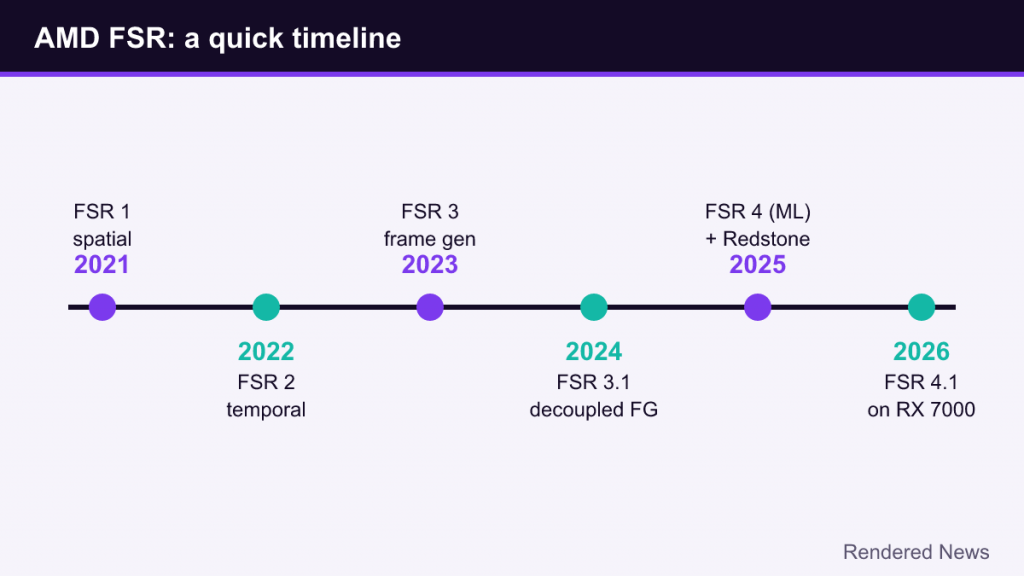
A quick timeline
- 2021: FSR 1, a spatial upscaler running on almost any GPU.
- 2022: FSR 2, temporal reconstruction with motion vectors and depth.
- 2023: FSR 3, adding frame generation and Native AA.
- 2024: FSR 3.1, decoupled frame generation and better stability; driver-level Fluid Motion Frames.
- 2025: FSR 4, ML-based upscaling for RDNA 4; in December, the FSR Redstone suite with ML Frame Generation, Ray Regeneration and a Radiance Caching preview.
- 2026: FSR Upscaling 4.1 extended to Radeon RX 7000 desktop GPUs.
The direction is clear: FSR has moved from “good enough everywhere” toward “best quality on supported hardware, with fallbacks elsewhere.” That mirrors the industry as a whole, where upscaling, denoising and frame generation are increasingly handled by neural networks working from the same core inputs that the rasterization pipeline has always produced.