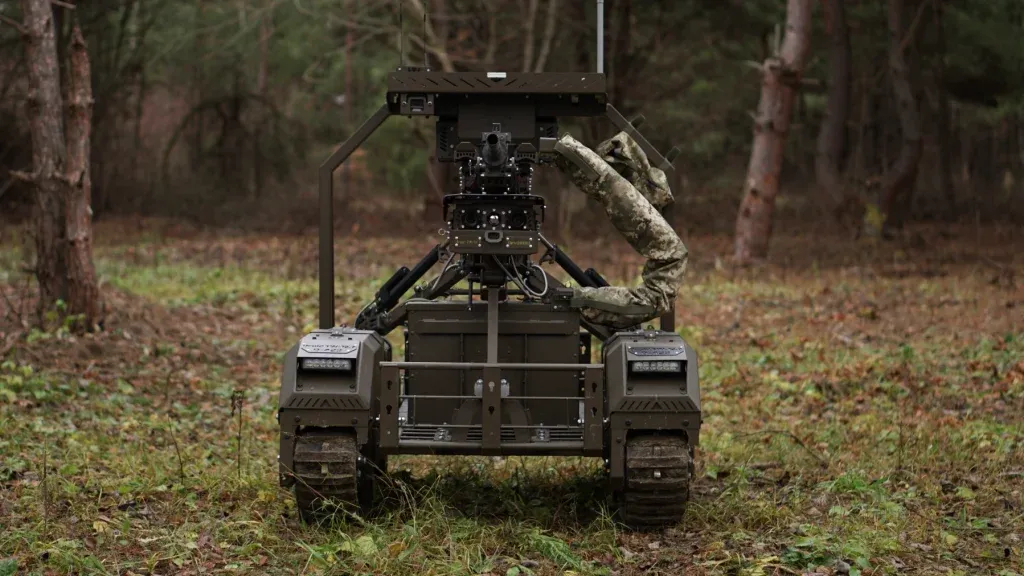
In a significant demonstration of modern warfare capabilities, Ukraine’s 33rd Assault Brigade has successfully deployed a ground combat robot in coordination with unmanned aerial vehicles to eliminate a Russian military position. The operation showcased the Droid TW 12.7, a domestically developed unmanned ground vehicle equipped with heavy weaponry, marking another milestone in Ukraine’s growing use of robotic systems on the battlefield. This successful engagement highlights the increasing role of autonomous and semi-autonomous systems in contemporary combat operations, as both sides in the conflict continue to innovate and adapt their military technologies.
The Droid TW 12.7: Ukraine’s Ground Combat Innovation
The Droid TW 12.7 represents a significant advancement in Ukrainian military robotics. This unmanned ground vehicle is equipped with a 12.7mm heavy machine gun, capable of providing substantial firepower while keeping human operators at a safe distance from enemy fire. The platform is designed to navigate challenging terrain and can be controlled remotely, allowing operators to engage enemy positions without direct exposure to hostile fire. The system’s integration with drone surveillance provides real-time targeting data, creating a highly effective combined arms approach at the tactical level.
Ukrainian defense manufacturers have rapidly scaled up production of various robotic systems since the full-scale invasion began in February 2022. The conflict has become a testing ground for innovative military technologies, with both commercial and purpose-built drones playing increasingly crucial roles. Ground-based robotic systems like the Droid TW 12.7 represent the next evolution in this technological arms race, offering capabilities that complement aerial drones while providing sustained firepower that smaller UAVs cannot deliver.
Combined Arms Tactics: Integrating Robots and Drones
The successful operation by the 33rd Assault Brigade demonstrates the effectiveness of combining multiple unmanned systems in coordinated attacks. In this engagement, reconnaissance drones likely provided surveillance and target identification, while the ground robot delivered the kinetic effect against the Russian position. This multi-domain approach to unmanned warfare represents a significant tactical innovation, allowing Ukrainian forces to conduct offensive operations with reduced risk to personnel. Military analysts have noted that such combined unmanned operations could reshape how future conflicts are fought.
The 33rd Assault Brigade, also known as the “Hunters,” has established itself as one of Ukraine’s most capable units, frequently operating in some of the most contested areas along the front lines. Their adoption of cutting-edge robotic systems reflects a broader trend within the Ukrainian Armed Forces to embrace technological solutions that offset personnel limitations and reduce casualties. The brigade’s experience in integrating these systems into assault operations provides valuable lessons that can be applied across other Ukrainian military units.
The Future of Robotic Warfare in Ukraine
The deployment of ground combat robots alongside aerial drones signals a new phase in the evolution of warfare in Ukraine. Western military observers have closely monitored these developments, as the lessons learned in this conflict will likely influence military doctrine and procurement decisions globally. The relatively low cost of unmanned systems compared to traditional military hardware, combined with their effectiveness in combat, suggests that robotic warfare will continue to expand in scope and sophistication. Ukraine has announced plans to significantly increase its production of both aerial and ground-based unmanned systems throughout 2025.
As the conflict continues, both Ukrainian and Russian forces are expected to deploy increasingly advanced robotic systems. The successful integration of the Droid TW 12.7 with drone operations by the 33rd Assault Brigade demonstrates that Ukrainian forces are at the forefront of developing effective tactics for unmanned warfare. This technological edge, combined with continued Western support and domestic innovation, remains a critical factor in Ukraine’s defensive efforts against Russian aggression. The experience gained in these operations is creating a new generation of warfare specialists who understand how to effectively employ robotic systems in complex combat environments.
Expert Opinion: The successful deployment of ground combat robots in coordination with UAVs by Ukrainian forces represents a paradigm shift in infantry assault tactics. As both sides continue to innovate, we can expect robotic systems to become increasingly autonomous and capable, potentially reducing human presence on the front lines dramatically within the next decade. This conflict is effectively serving as the proving ground for 21st-century warfare technologies that will define military operations for generations to come.