
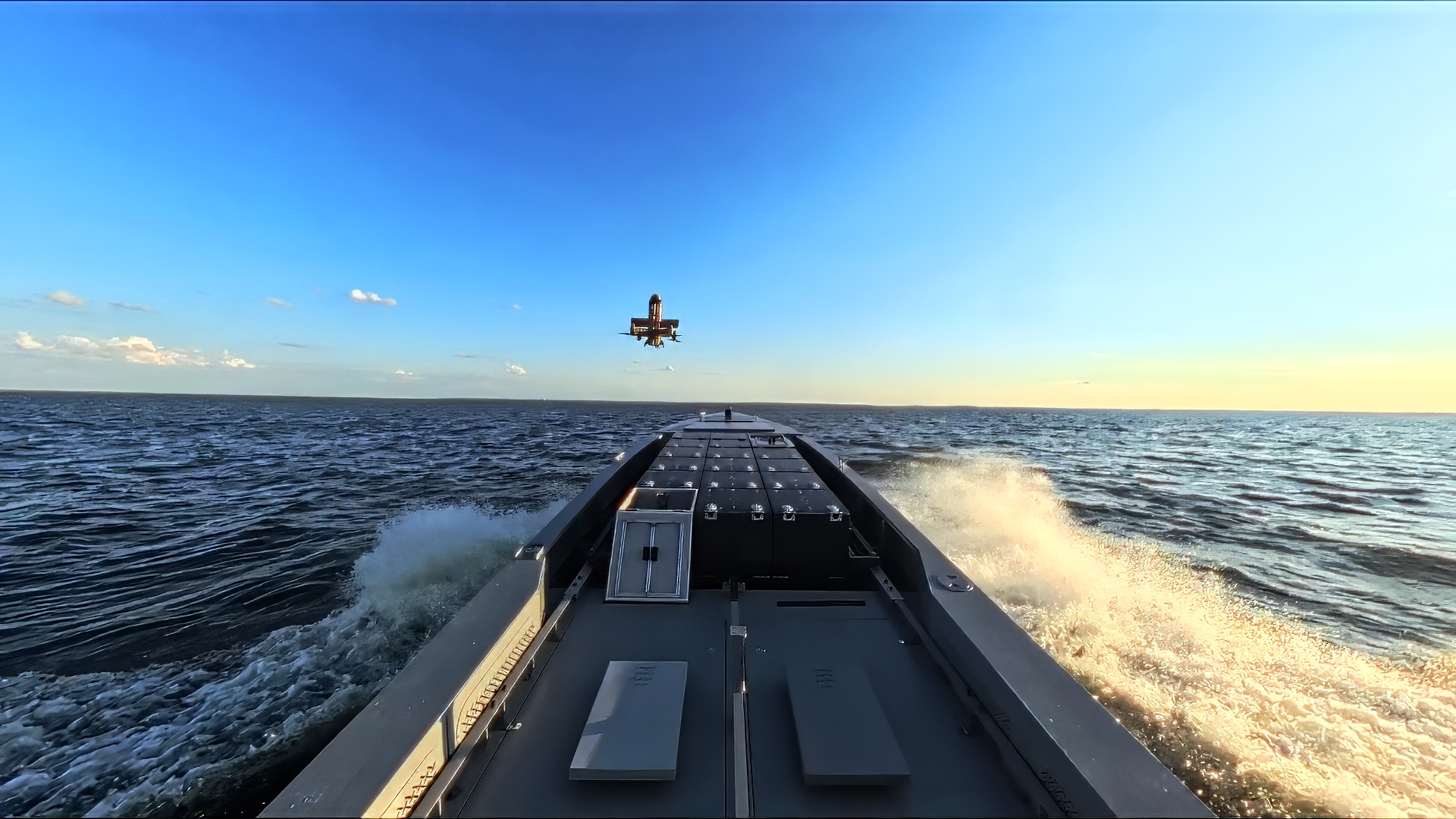
Ukrainian defense technology company Uforce has officially introduced its latest innovation in unmanned naval warfare — the MV11 maritime drone. This new model represents a significant leap forward in autonomous naval capabilities, as it becomes the largest vessel in the company’s acclaimed Magura series. What sets the MV11 apart from its predecessors and competitors is its groundbreaking ability to serve as a launch platform for other unmanned vehicles, effectively creating a mother ship concept for drone operations at sea.
The unveiling of the MV11 comes at a critical time when unmanned systems are revolutionizing modern warfare, particularly in contested maritime environments. Ukraine has emerged as a global leader in innovative drone technology, driven by the necessities of the ongoing conflict and the need to challenge conventional naval superiority with asymmetric solutions. The Magura series has already proven its effectiveness in numerous operations, and the MV11 promises to expand these capabilities significantly.
Technical Specifications and Revolutionary Capabilities
The MV11’s most distinctive feature is its capacity to deploy other unmanned systems while operating at sea. This multi-domain capability transforms a single maritime drone into a mobile operations center, capable of extending its reach through aerial reconnaissance drones or smaller surface vessels. Such functionality has traditionally been reserved for full-sized naval vessels, making the MV11’s compact implementation of this concept particularly innovative. The platform’s increased size compared to earlier Magura variants allows for greater payload capacity, extended operational range, and improved sea-keeping abilities in rougher conditions.
Defense analysts suggest that this mother ship concept could fundamentally change naval tactics in littoral warfare. By dispersing launch capabilities across multiple autonomous platforms, naval forces can create more resilient and harder-to-detect operational networks. The MV11 could potentially carry reconnaissance drones that provide over-the-horizon targeting data, electronic warfare systems, or additional strike capabilities, multiplying its tactical value exponentially.
The Evolution of Ukrainian Maritime Drone Technology
Ukraine’s development of maritime drones has been one of the most remarkable technological success stories to emerge from the current conflict. Beginning with relatively simple remote-controlled vessels, Ukrainian engineers have rapidly iterated designs based on combat experience, producing increasingly sophisticated platforms. The Magura series, in particular, has gained international recognition for its effectiveness against larger conventional naval vessels. Previous models have demonstrated the ability to strike targets at significant ranges while evading detection and countermeasures.
The progression from the original Magura designs to the MV11 reflects lessons learned from hundreds of real-world operations. Each generation has incorporated improvements in navigation systems, communication resilience, stealth characteristics, and payload delivery mechanisms. The MV11 represents the culmination of this rapid development cycle, incorporating artificial intelligence elements for autonomous decision-making and enhanced coordination with other unmanned systems in complex operational environments.
Strategic Implications for Modern Naval Warfare
The introduction of the MV11 signals a broader shift in maritime strategy that extends well beyond the current conflict. Naval powers worldwide are closely studying Ukraine’s innovative use of unmanned surface vessels, recognizing that these relatively inexpensive platforms can pose significant threats to conventional warships costing hundreds of millions of dollars. The asymmetric advantage provided by such systems is forcing navies globally to reconsider their force structures, defensive systems, and operational doctrines.
Industry experts predict that the drone-launching capability demonstrated by the MV11 will become a standard feature in future unmanned naval systems. The ability to create distributed, networked attack capabilities using autonomous platforms represents a paradigm shift comparable to the introduction of aircraft carriers in the early twentieth century. As these technologies mature, they promise to reshape naval power projection and coastal defense strategies for decades to come. Uforce’s continued innovation positions Ukraine at the forefront of this transformation, with the MV11 serving as a proof of concept for next-generation maritime warfare systems.
Expert Opinion: The MV11 represents a critical evolution in unmanned naval systems, demonstrating that drone swarm concepts can be implemented at relatively low cost with significant tactical impact. This mother ship capability effectively decentralizes naval strike power, making traditional fleet defense strategies increasingly obsolete. We can expect major navies to accelerate their own programs in this direction, while also investing heavily in counter-drone technologies to address this emerging threat.